
BlogArticle
Training hard may not be enough
13 min read, Published
A tiring class feels like proof that you are getting better at fighting. It is not, and the gap between the two is what this article is about.
Is training hard the same as training against resistance?
No. I have trained in many dojos and gyms, and I have regularly been impressed by how hard people can train. Hard training toughens the mind and body. But it does not necessarily mean knowing how to fight or defend yourself.
Hard training is about effort: fitness, intensity, sweat. Resistance training is about your partner: they are trying to stop you, and they are trying to win. A class can be exhausting and still be completely cooperative.
Drills have a clear, defined role: they teach a movement, usually with little or no resistance, and build the muscle memory. But once that muscle memory is there, you need to move beyond drills.
What does make-believe look like?
Make-believe is a technique claimed to work reliably that has never been tested against someone who resists. You will recognise the phrases:
- "I do that and your arm breaks."
- "Hit the pressure point and he lets go."
- "He punches, and I grab his arm."
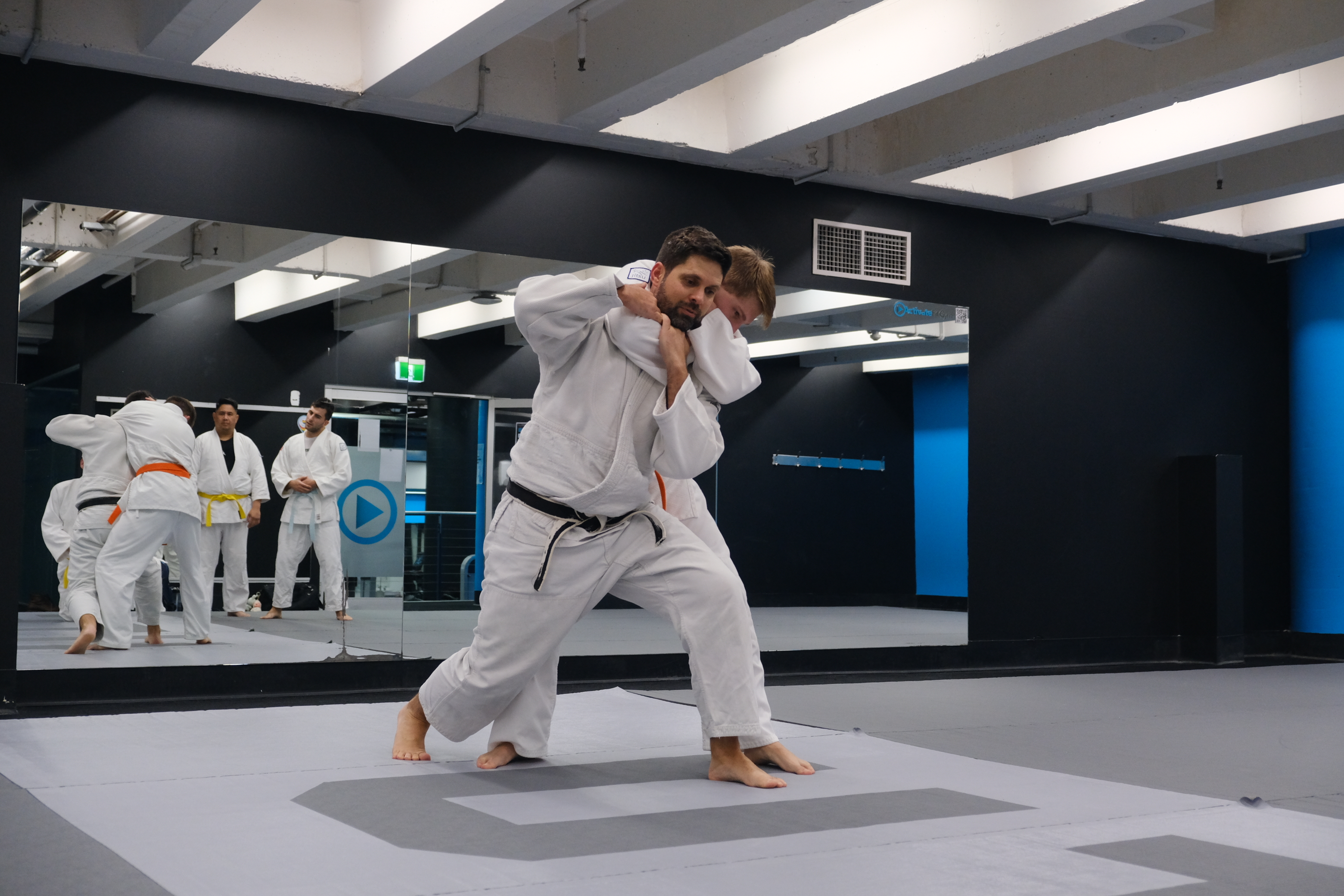
Franck demonstrating a defence against a standing rear naked choke. These defences are controversial, and BJJ influencers often replicate them to show they do not work. How do you make sure yours does?
Tapping to a lock, or falling over when you are receiving a technique in a demonstration, can hint at the right mechanics. But doing it with a cooperating partner is very different from doing it on someone who is resisting. So how do we make sure that what we train is useful in a real fight or self-defence situation?
Critical thinking is hard when the subject is completely new to you. The first step is to separate what you were told from what you were shown. Then ask:
- Could this work at full speed?
- Does it still work if my partner resists?
- What if my partner is much bigger or stronger?
And watch for these answers, because they are warning signs:
- "It would work, but it is too dangerous to train."
- "It works because of the pain."
- "It works in steps (X, then Y), but with no clear explanation of the mechanics: the leverage, the two-on-one, the balance."
The harm is not the claim itself. It is the confidence it builds, which only gets tested on the worst possible day.
Does any legitimate technique always work?
No. No legitimate technique or strategy is infallible. Every technique has drawbacks. Focusing on one limb can cost you your base, and keeping your base can mean less control of your partner. But be careful not to fall into the "what if?" trap, where every technique is dismissed because it has a counter.
This is where the difference starts to show. An instructor who has practised against resistance can explain those trade-offs, because they have felt them fail. "This always works" is a warning sign. "This works if..., and here is what to do when it doesn't" is a good sign.
What is the difference between direct and inherited experience?
Direct experience is what you have personally felt work, or fail, against a resisting partner. Taking someone's balance and throwing them is a clear example: you feel the moment the balance goes, and you know straight away when it has not.
Inherited experience is what you were told should work but have never been able to test. Gouging an eye, a pressure point that makes a person let go, or a debilitating strike are examples. They may be true, but you cannot know, because you cannot practise them at full intensity on a resisting partner. There is also a human question: would you commit to something like an eye gouge under stress if you had never practised it realistically? Grappling can be tested every week. Gruesome techniques cannot.
Inherited experience is not worthless. The problem is how it decays. An experienced fighter may have used a technique successfully, but a few generations later the critical details that made it work may have been lost. Nobody can correct the drift, if nobody tests it.
Let resistance practice decide what sticks. Once a movement is learned, drilling it more does not tell you whether it works. Live practice does. If you prefer one grip over another, find out in a resisting game whether it really works, rather than relying on "this is how we have always done it".
This does not mean instructors have nothing to add. A good instructor can explain why one way is better than another, even when both work, using principles such as base, leverage and timing. The difference is that the reasoning stays open to testing.
Do joint locks work in a real fight?
Yes. But why they work matters more than whether they work.
What is the difference between pain compliance and biomechanical control?
Pain compliance means using pain (joint pressure, strikes to sensitive spots, nerve points) to make someone cooperate. In training, your partner taps because they are cooperative. That creates a loop where we learn to rely on pain as the thing that controls people.
Outside the dojo, pain is unreliable. Adrenaline, alcohol, drugs or sheer determination can switch it off. An attacker who does not respond to pain has not been controlled. They have only been hurt, and potentially got angrier.
Biomechanical control is different. A good shoulder lock controls the arm and shoulder not because it hurts, but because the shoulder is not strong enough in a given direction and range. The pain is a by-product of reaching the joint's structural limit. A joint that cannot move cannot move, whether or not the person feels it.
So the question to ask is: "Does my technique work because it hurts, or because it exerts leverage limiting my opponent's moves?"
Why does threatening a lock fail?
In Meditations on Violence, Rory Miller describes a two-on-one assault. He had the bigger attacker's arm locked on the ground and planned to threaten the other brother: "Back off or I'll break his arm!" He suggests you count how many times you can kick something in the time it takes to say that sentence. In the real event, he was kicked in the head repeatedly while he was talking, and he remembers three of the kicks distinctly. He opens the story by calling it "the potentially fatal and stupid decision not to hurt them".
Miller also explains why a threat can fail in principle: in martial sports, a joint lock is "a negotiation for surrender". A negotiation needs someone who understands you and wants to stop. A frightened, drunk or determined attacker may not.
What happens when a joint tears?
Even a successful break can backfire. Once a joint is torn, the limb is no longer stopped by the joint's structural limit, so the lock that was controlling the person has stopped working. The pain alone may not stop a determined attacker. You need a next move: another lock or pin, disengaging, or a strike or strangle.
Paul Cale, a former Australian special forces commando with five deployments to Afghanistan and Iraq, gives a first-hand example. In a 2017 interview with the Newcastle Herald, he recalled a fight in Afghanistan where he grabbed a Taliban fighter's arm to free a fellow soldier's weapon: "I ended up busting his arm and grabbed his neck and strangled him." The broken arm did not end the fight. He still had to go for the neck. I also heard him tell this story when I attended a Kinetic Fighting course.
Are standing locks still worth learning?
On the ground, the mat, gravity and your whole body help hold someone still. You can use all your limbs (arms, legs and head) and put your weight on them, so you can secure a controlling position before applying a submission. Standing, you cannot put your weight on them. Your arms are often the only way to tether your upper body to theirs, and they can move their whole body to relieve the pressure. With less control, a standing lock often needs a sudden snap to finish, which is risky to practise at full intensity. That makes standing locks harder to land, and it is why they are rarely seen in combat sport, where they are often excluded for safety reasons. It does not make them useless. They can still be valuable, and later in this article we look at how best to train them.
Can compliance pass for resistance?
The final risk is that we, and our training partners, have been conditioned to comply while thinking we are still resisting or making it hard. This can happen in any martial art, on purpose or subconsciously. Practitioners learn to move or behave a certain way, and realism drops.
Matt Thornton, founder of Straight Blast Gym, calls the alternative aliveness: training with timing, energy and motion against an opponent who is really trying. He is careful to separate it from effort: "Anyone whose ever had a slow roll in BJJ, knows that training Alive, and training hard and or fast, are not necessarily synonymous." In his words, "It's not about the speed of the movement. It's about the Alive opponent."
A quick check: look at what newcomers are allowed to do. If the techniques do not work on a white belt, is it the novice's fault? Almost certainly not.
This also applies to legitimate arts such as Brazilian Jiu-Jitsu and Judo. If you say your art is great for self-defence, do you ever train scenarios outside the sport's rules? How often do you include strikes?
What does built-in compliance look like?
The attacker throws one punch and freezes, waiting for the defence. Repeat that hundreds of times and both people learn the same lesson: attacks come one at a time, then stop. The attacker learns to pause. The defender learns that the attack is over. In a real fight, the second and third punch arrive. Nobody planned this habit. It simply grows out of drills where the partner is never trying to win.
What goes wrong when only one side can win?
If only the defender can win, as in a gauntlet or a drill where one person is attacked repeatedly, the attacker has every incentive to make it look good. Resistance turns into acting.
How do you set up resistance training?
The best way is to define winning conditions for all participants. A scenario where the attacker cannot win is unlikely to produce real resistance.
The winning conditions can be the same for both partners, as in every combat sport: throw the other person on their back. Or they can differ, as in guard passing, where the top person wins by passing and the bottom person wins by sweeping or standing up. Different conditions also suit practising one part of a situation, or a specific self-defence scenario.
A winning condition can be:
- An event: the opponent taps, or gets swept.
- A time limit: you keep a hold for ten seconds.
Constraints are then added for safety, and to train specific skills. For example, to practise escaping the mount, the same person can start in the mount for two minutes, every time. The escaper gets two full minutes of practice, no matter how often they get out.
It also helps to keep score some of the time. Reaching a clear win or loss is what keeps both sides honest.
What is pressure training?
Pressure is not the same thing as resistance, and each builds something different.
Resistance is about your partner: they have a conflicting goal and work against you. Pressure is about the conditions: anything that makes it harder to perform. You can have one without the other. A calm sparring round has resistance with little pressure. A graded demonstration in front of a panel has pressure with a cooperative partner.
There are many types of pressure:
- Being watched: an audience, a grading panel, a coach.
- High stakes: a competition, a medal, a ranking.
- Fatigue: being tired and out of breath.
- Surprise: random attacks, attacks from behind.
- Disadvantage: bigger and stronger attackers, unarmed vs armed.
Competition is one type of pressure, and a valuable one. It adds the stress of performing, sticking to a game plan, warming up properly, eating right, and handling delays on the day. The higher the level, the higher the stakes.
But it may not be the best type for self-defence. In competition you choose to be there, you prepare for it, and you arrive rested, stretched, warmed up and hydrated, with agreed rules and a referee. A real attack will not wait for your best day.
Pressure aimed at self-defence should test the worst conditions instead: exhaustion, bigger and stronger attackers, or starting with your eyes closed. It puts you in the worst possible conditions and shows whether your training still holds.
You need both pressure and resistance, and you need time for each. Set aside regular time for resistance without pressure, pressure without resistance, and both pressure and resistance together.
What about techniques rarely used in combat sport?
Some techniques are rarely seen in combat sports. Rules may ban them, or skilled opponents may shut them down so reliably that they almost never score. A low success rate in sport does not automatically make a technique useless. It may still help against an unskilled, drunk or unprepared attacker, which is a very different situation.
Standing wrist locks and arm locks are a good example. Against a skilled grappler they are very hard to apply, and they are often forbidden in sport because of the sudden, snapping way they have to be applied. Against someone with far less skill, they can help you control a person without hurting them badly. Two conditions should both hold: you are confident the skill gap is overwhelming, and the problem can be solved by moving them away, such as walking them outside. If either fails, a lock is the wrong choice.
Why are these techniques hard to train?
These techniques are hard to train honestly:
- Against a cooperative partner, you learn nothing.
- Against a skilled, fully resisting partner, you mostly fail, just as in the sport.
How do you train them? Asymmetric constraints
The best answer I have is to restrict what each partner is allowed to do, so the two sides play different games. For example, one partner may only strike. The other may strike, grapple and throw. The striker wins by landing a set number of clean strikes. The other wins by controlling or submitting. Both sides can win, both are trying, and the technique gets room to appear.
This also helps against "punch and wait". The attacker is trying to land something, not waiting politely. And the defender practises what matters: controlling the fight and not getting knocked out.
Be honest about what this proves. Constraints make a technique possible to practise. They do not prove it works against a skilled fighter. Say which one you are doing.
So what should you do?
The goal is to be able to defend yourself, without building a belief in skills that do not translate to reality. None of this is an argument against tradition. It is an argument for honesty: keep what you have verified, mark what you have only inherited, and test as much of the second pile as you safely can.
Pressure training has to be done together with practice against resisting partners. Use critical thinking to identify the assumptions made in your training, and train under both pressure and resistance, so your skills are where you believe they are.
Five questions to test your training
- Does my partner actually try to stop me, and can they win? If not, you are drilling, not testing. Drills teach a movement. Resistance means your partner has a goal that clashes with yours, so you find out whether the technique works when they do not help.
- Do I know this works because I have felt it work, or because I was told? If you have felt it work against a resisting partner, that is direct experience. Everything else is inherited experience, and it stays unproven until you can test it.
- Does it work because it hurts, or because my opponent cannot move? Pain is unreliable in a real fight, because adrenaline, alcohol, drugs or determination can switch it off. A lock that stops a joint from moving works whether or not the person feels it.
- What is my next move if it fails? No technique always works, and a torn joint stops controlling the limb. Have a next move ready: another lock or pin, disengaging, or a strike or strangle.
- Do I ever practise outside the sport's rules: with strikes, tired, or by surprise? Competition is one kind of pressure, but a real attack will not wait for your best day. Test your skills under the worst conditions.
Sources and further reading
- Rory Miller, Meditations on Violence (YMAA, 2008).
- Damon Cronshaw, "I strangled a Taliban fighter in Afghanistan", says former commando, Newcastle Herald, 16 March 2017.
- Matt Thornton, "It's Aliveness – Still", mattthornton.org, 16 May 2017.
About the author: Franck Royer is head instructor at UTS Jitsu, which brings Sydney Jitsu's practical Japanese Jiu-Jitsu to the UTS Ultimo campus in Sydney. He holds a first degree black belt in Shorinji Kan Jiu-Jitsu (The Jiu-Jitsu Foundation lineage) and a purple belt in Brazilian Jiu-Jitsu under Ben Power at Straight Blast Gym Australia. He has been a martial artist for more than 25 years and an instructor for 13 years. You can read more about him and the other instructors on the UTS Jitsu instructors page.
Comments
Loading comments...
Log in to join the conversation.